Depression
Home › Exercise For › Depression
Depression
Depression
Depression is a serious illness but we can combat it through various exercises and yoga for depression. It is very different from the common experience of feeling unhappy, miserable or fed up for a short period of time. Depression is quite common and about one in ten people experience depression at some point or other. Women are more likely to have depression than men, and 1 in 4 women will require treatment for depression, compared to 1 in 10 men. Suicidal tendency is comparatively more in women than men, probably because men are less likely to seek help for depression. People with a family history of depression are more likely to experience depression themselves.
Depression can mean just being in low spirits. It doesn't stop you from leading a normal life, but makes everything harder to do and seem less worthwhile.
At its worst, major depression (clinical depression) can be life-threatening, because it can make people suicidal or simply give up the will to live.
The disease may aggravate if we do not take immediate step to treat this problem. For curing this mental disease, we can avail the Benefits of Yogapathy, since there can be no better substitute than yoga for depression as a remedy.
Different types of Depression
Depression affects people in many ways and can cause several physical, psychological (mental) and social symptoms. Depression is a serious illness with real effects, and it is certainly not a sign of failure. There are different types of Depression which are highlighted below:
Seasonal Affective Disorder (SAD):
When you usually become depressed only during a particular season, i.e. in autumn and winter, it could be due to not getting enough daylight.
Bipolar Disorder (Manic Depression):
When periods of depression alternate with periods of mania, some people said to have mood swings. When manic, they are in a state of high excitement, and may plan and may try to execute grandiose schemes and ideas.
After a short manic phase the Person may feel depressed for a long time. Lack of energy and motivation is characteristic of this phase. This period is just the opposite of the manic stage and often lasts long.
At least one person in every six becomes depressed in the course of their lives. All age groups can be affected, and it's important to take symptoms seriously and not to dismiss them as an inevitable part of growing up or growing old. By recognizing and treating the symptoms and getting help, it's possible to overcome depression, and prevent it coming back.
Postnatal Depression
Many mothers have 'the baby blues' soon after the birth of their baby, but it usually passes after a few days. Postnatal depression is a more serious problem and can appear any time between two weeks and two years after the birth.
Yoga Research on Depression
A study was done to examine the efficacy of yoga therapy as a complementary treatment for psychiatric disorders such as schizophrenia, depression, anxiety, and posttraumatic stress disorder (PTSD) in Department of Psychology, California State University, Northridge, California, USA. The combined analysis of all 10 studies provided a pooled effect size of -3.25 (95% CI, -5.36 to -1.14; P = .002), indicating that "yoga-based interventions have a statistically significant effect as an adjunct treatment for major psychiatric disorders."
Findings in support of alternative and complementary interventions may especially be an aid in the treatment of disorders for which current treatments are found to be inadequate or to carry severe liabilities. This study concluded, as current psychopharmacologic interventions for severe mental illness are associated with increased risk of weight gain as well as other metabolic side effects that increase patients' risk for cardiovascular disease, yoga may be an effective, far less toxic adjunct treatment option for severe mental illness.
According to another research, Yoga is believed to have beneficial effects on cognition, attenuation of emotional intensity and stress reduction. A study conducted by Memory Studies Laboratory, Federal University of Rio Grande do Norte (UFRN), Natal, RN, Brazil showed long term Yoga practitioners have improvement of the memory performance, as well as improvements in psychophysiological parameters. The present results suggest that "regular yoga practice can improve aspects of cognition and quality of life for healthy individuals."
Studies also support that "Yogic relaxation therapy leads to conscious and subconscious recognition of underlying psychological factors and helps releasing of suppressed conflicts." The patients with mild to moderate anxiety and depressive symptoms improved significantly with 'Yoga Nidra' intervention.
Tips to Prevent Depression
Try to recognize the pattern of negative thinking when you are doing it, and replace it with a more constructive activity. Look for things to do that occupy your mind.
You need to do things that will improve the way you feel about yourself. Allow yourself positive experiences and treats that reinforce the idea that you deserve good things. Pay attention to your personal appearance.
Although you may not feel like it, it's very therapeutic to take part in physical activities, for 20 minutes a day.
Playing sports, running, dancing, cycling, and even brisk walking can stimulate chemicals in the brain called endorphins, which can help you to feel better.
But don't miss out the practice of yoga to get relief from Depression and Anxiety.
Reap the Benefits of Yoga for Depression Treatment
- Strengthens our nervous system.
- Calms the mind and helps in attaining peace.
- Helps to improve concentration, create inner harmony and balance the mind and body.
- Alleviates stress and produces endorphins in our body.
- Provides energy to the body by relieving tiredness and fatigue.
- Stimulates the brain and helps to build confidence.

Yoga Breathing
Sit in Easy pose. Inhale fully expanding abdomen and chest. Exhale slowly and completely. Practice for 5 minutes with intention of releasing negativity on each exhale. Focus on keeping your breath steady and rhythmic.
Benefits: This breathing exercise if done religiously, helps to keep a check on our wavering mind.
Deep Breathing With Folding Hands
Stand straight. Fold your hands in front. Inhale deeply while raising your folded hands above your head. Exhale while bringing hands back down. Do this for 10 times slowly and mindfully.
Benefits: Practicing this exercise regularly will help to keep our mind under control and erase out negative thoughts.


Upper Body Twisting
Instructions:
- Stand straight. Rest your right hand on right side of the body and vice versa.
- Breathe in and twist toward rightward.
- Breathe out and come back to normal position.
- Again breathe in and twist your body toward leftward.
- Breathe out and come back to normal position.
Continue for 20 times. Take rest for a few seconds.
Benefits: Strengthens the body muscles and relieves fatigue and tiredness and relaxes the mind.
Back Arching and Toe Touching
First Movement: Inhale, stretch the hands upward and take them backwards. Look towards the sky. To the extent possible, bend backwards from the waist. Hold and count 10.
Second Movement: Exhale and while bending the hands in the front, rest them near the feet on the ground. If possible touch with the palms and try to touch the knees with the head. Hold and count 10.
Repeat 3 times. Then take rest.
Benefits: Strengthens the back muscles and enables the mind and body to work parallel without any hindrance.

Bow Pose
Lie on your abdomen. Bend your knees. Hold your ankles with respective hands and lift your body. The body will look like a bow. Hold the posture and count 10. Come back and again repeat the same. Take rest in Corpse pose.
Benefits: Soothes the mind and strengthens the body muscles.
Half-Spinal Twist
Get complete relief from lower back pain and stiffness by practicing this along with other exercises. It increases the elasticity of spine and stretches the shoulders, hips, neck and hands.
- Sit down on the ground. Stretch both the legs in front of you.
- First fold your right leg followed by the left leg.
- Now with your left hand hold the right knee.
- Then move your upper part of the body to right side and right hand will go back.
- Head and neck will move toward right side. Count.
- Now right hand will hold the left knee.
- Then move your upper part of the body to left side and left hand will go back, count.
- Head and neck will move toward left side.
- Then take rest in Corpse pose.
- Now change your legs, i.e. fold your left leg followed by the right leg and do the same with your hands as stated above.
- Then take rest in Corpse pose. This is known as one set.
Benefits: Benefits the whole body system and enables us to keep our mind steady. Relieves lower back pain and erases stiffness between vertebrae. Stretches the shoulders, hips, neck and hands. Regulates secretion of pancreas, hence useful in diabetes.
Breathing Exercise
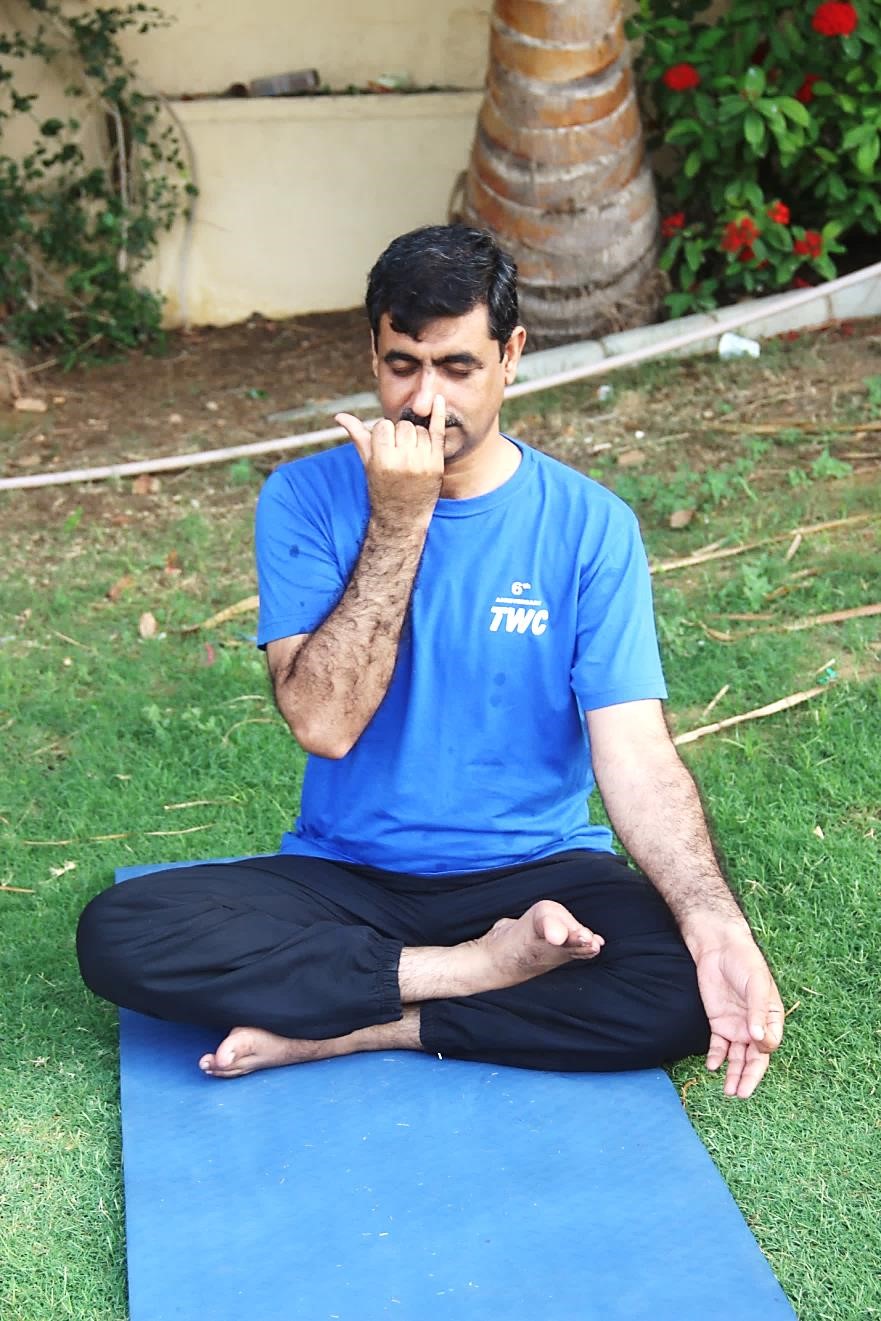
Sit in Easy and close your left nostril with ring and little finger. Close your eyes and breathe in through right nostril. Block right nostril with thumb and breathe out with left nostril. Again breathe in with left nostril. Close left nostril and breathe out with right nostril. Do this for 10 times. Change your legs and again do for 10 times.
Benefits: Easiest and practical method to cure both physical and psychological problems.
Meditation
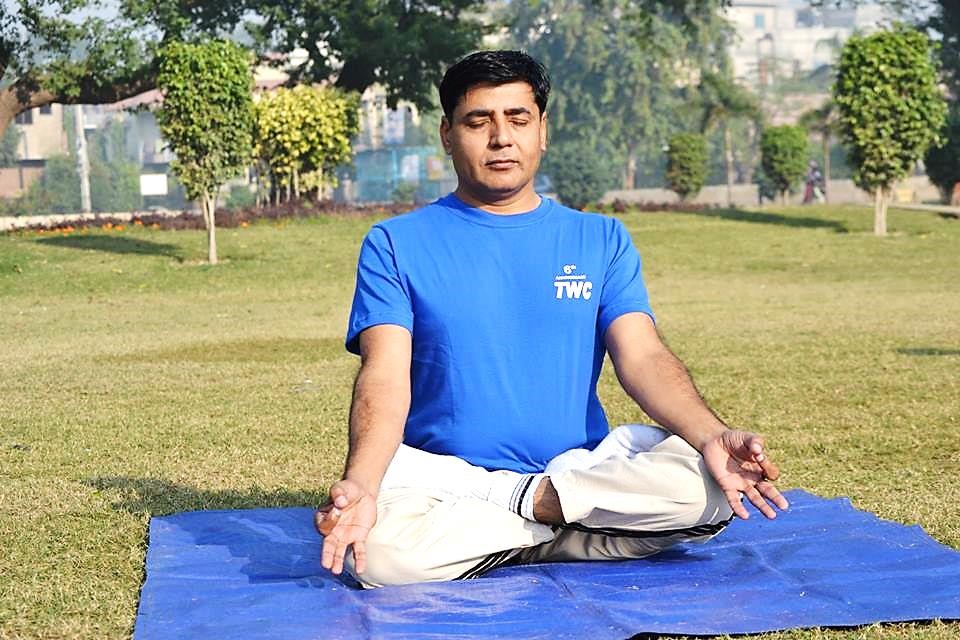
Sit in Lotus pose. Close your eyes. Concentrate in any one object or in your third eye (in between two eye brows). Do not think of any other object. The person can silently repeat a word or phrase preferably ALLAH. Do this for 5 minutes.
Benefits: Helpful in eradicating both physical and emotional troubles.

Corpse Pose
Lie down on your back and relax your whole body, as if you have gone to sleep. Place a cold towel on top of the eyes. In this posture, keep the mind clean from all worries and thoughts. Do this for 5 minutes.
Benefits: The best pose for a tension-free mind.